

The closely watched frontier AI model maker filed its public S-1 on Monday following its previous “confidential” filing in June. At 318 pages, it talks about everything from financials and breakdowns of revenue to its supplier agreements.
The financials only go as far as June 2026, but there are also select metrics covering September, adding resolution to previously reported numbers from its privately held investor meetings.
In now-expected Anthropic fashion a whopping 94 pages, or 29%, of the filing was dedicated to risks spanning financial exposures, model misalignment, cybersecurity, semiconductor supply constraints, and consequences of advanced AI .
While the S-1 does show clear demand and improving economics, Anthropic ultimately represents a new kind of business, one that has software-like scalability potential, with substantial infrastructure commitments. It’s too early to tell whether its growth will result in lasting earning power.
That doesn’t mean it won’t have a successful IPO; the market still largely attributes AI to two companies, so I expect speculation to carry it in the short term provided market conditions are favorable.
I’m not currently planning to be a buyer at the IPO, but here are some highlights from the filing that I found interesting:
Improving margins, profitability, and moderating revenue growth
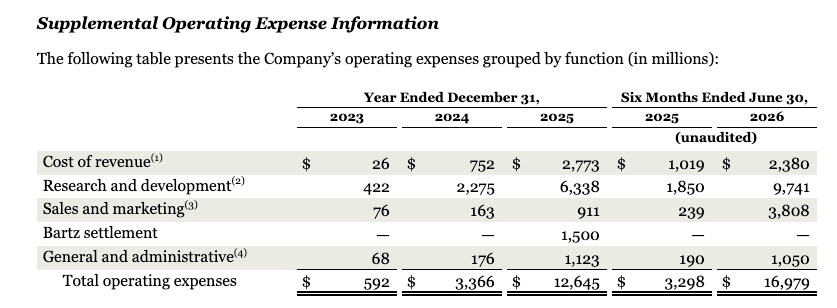
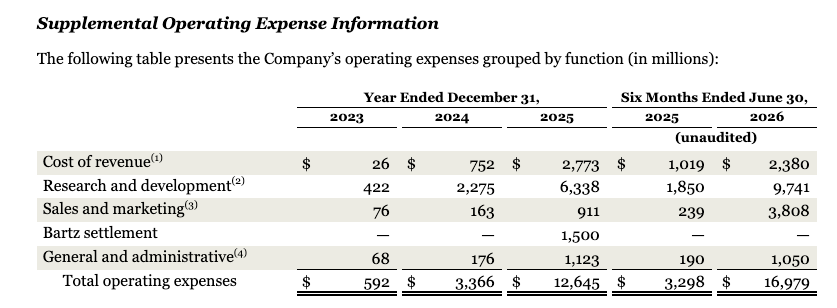
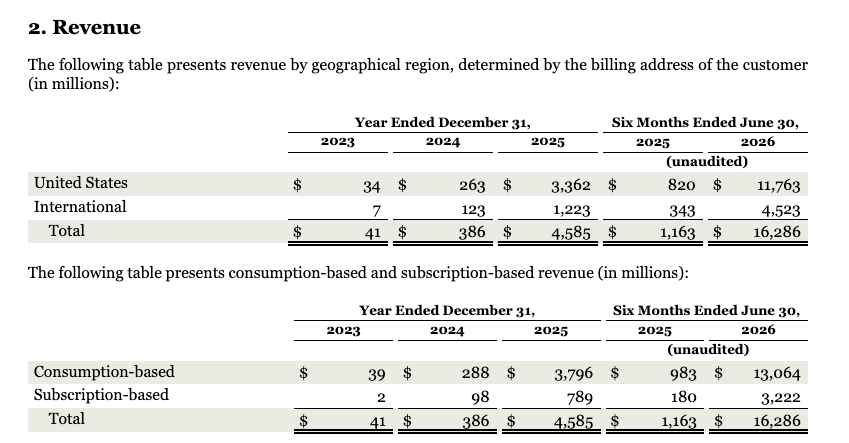
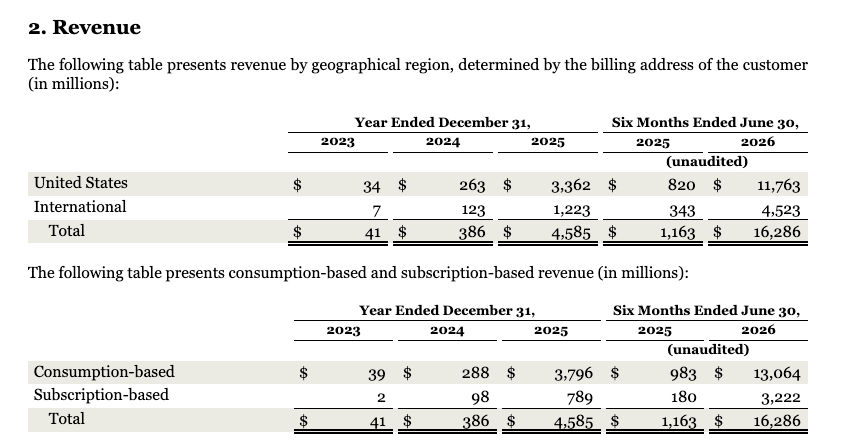
Revenue reached $16.3B in the first half of 2026 which is ~14 times the same period from last year while gross margin expanded from 12.4% to 85.4%. R&D alone totaled $9.7B, but Anthropic was still able to eek out a $974M operating profit, or 8.4% margin, and is trending in the right direction.
Later in the filing, they disclose revenue in Q3 to be 86x the revenue from a prior quarter, implying $17B. This represents 47% sequential growth which is down from 144% in Q2.


Growing base of high-spending enterprise customers
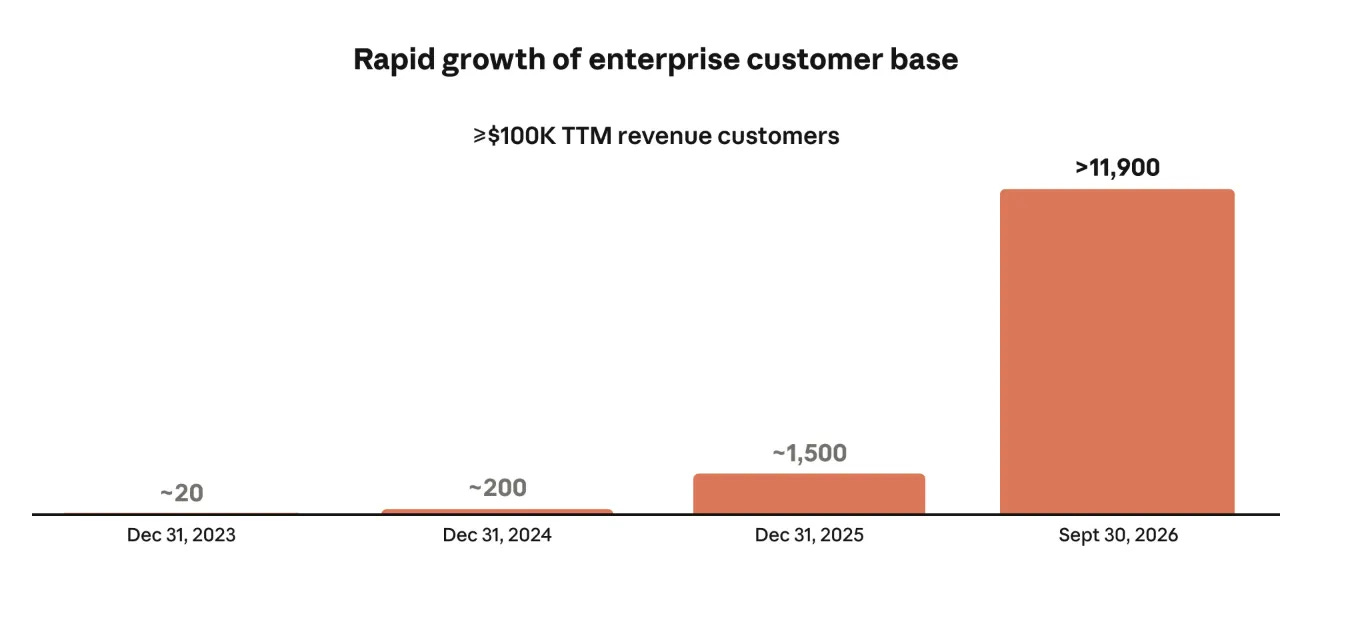
The number of customers generating at least $100K in revenue grew from roughly 1,500 at the end of 2025 to more than 11,900. While extraordinary, the durability of that spending remains unproven. Several friends running startups have already begun shifting substantial workloads to open-weight models.
Net loss and cash reserves
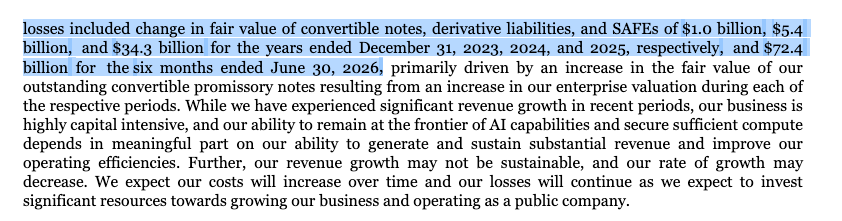
The filing shows a $80.7B first-half net loss which comes primarily from revaluing convertible notes as Anthropic’s valuation rose. Reports are already highlighting this signs of a unsustainable business. The increased value of those investor claims are recorded as liabilities and should not be treated as cash burned serving its models.
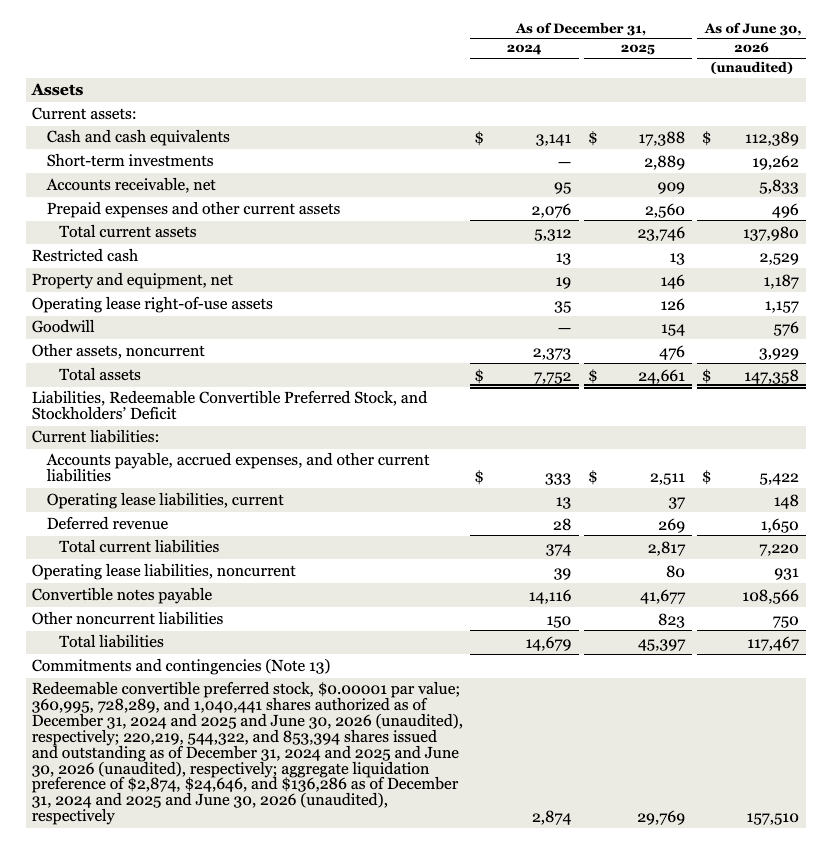
At the end of June 2026, Anthropic held an enormous cash balance of $112.4B, mostly from its raises. This is substantial liquidity, though cash requirements will change as more of its enormous compute commitments of ~$75B/yr come due.
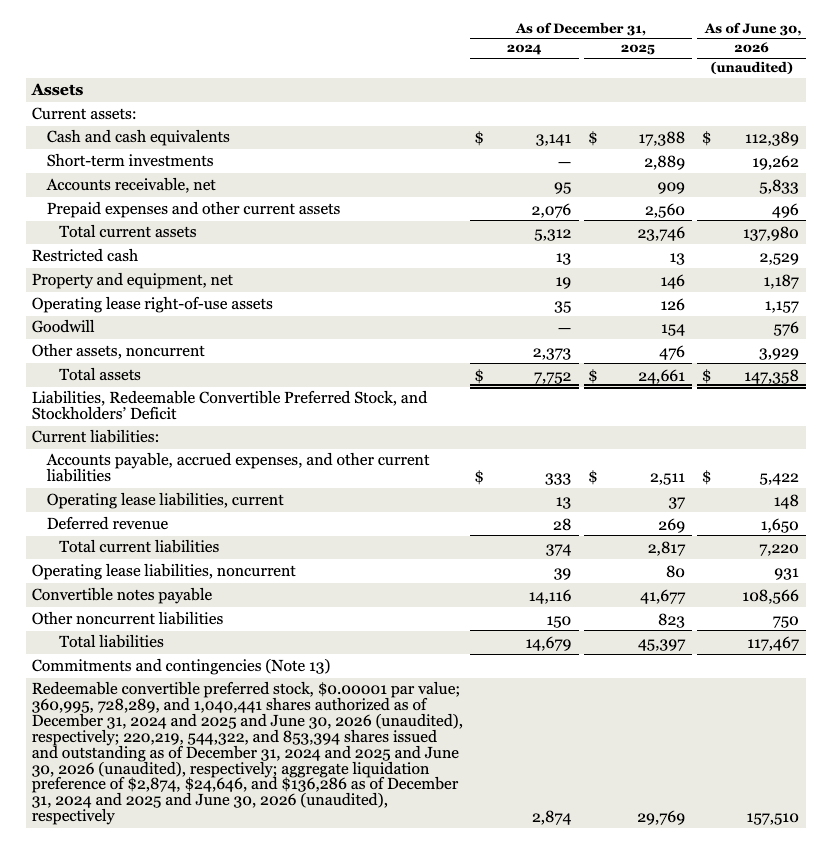
Here’s a fun one: Anthropic’s cash reserves generated $1.1B in interest income in the first six months of 2026 alone.


Improving compute economics
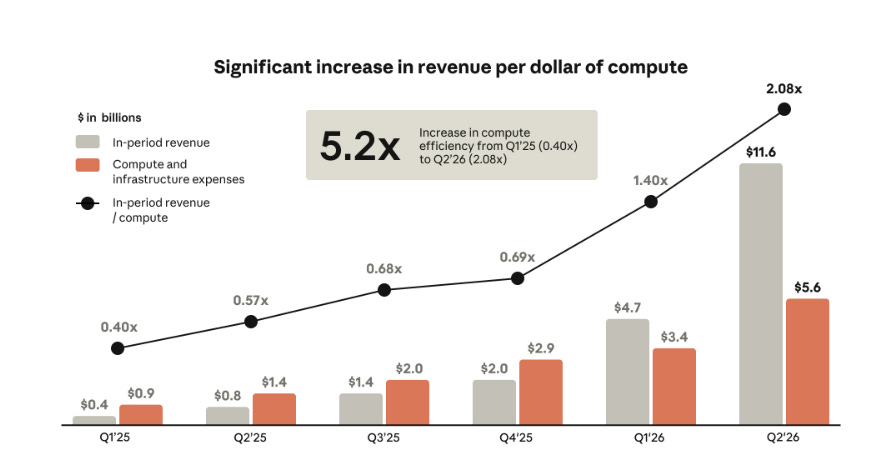
Revenue per dollar of total compute rose from $0.57 to $2.08 between 2Q25 and 2Q26. The filing describes two sources of improvement that we can expect to continue: reducing the compute required for a given level of model performance, and using that compute more efficiently in production. The ratio also reflects pricing and workload mix, so its trajectory shouldn’t be attributed entirely to technical efficiency.
Significant long-term compute commitments lock in costs
The filing discloses 7 key agreements. 4 of them combine for $431B in minimum cloud spend and equipment leases that mostly go through 2033. These are take-or-pay obligations, with payments due “regardless of actual usage”. Broadcom adds another $161.2B through five-year TPU equipment leases.
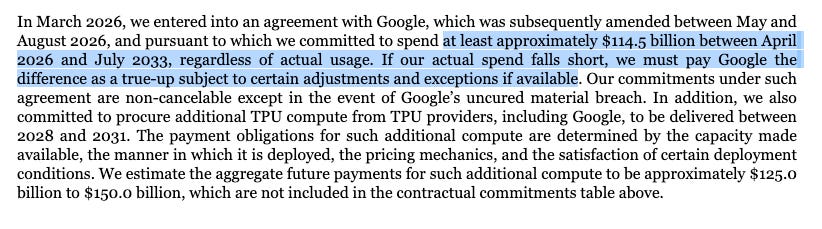
Another $206B covers SpaceXAI, and other providers, but these have different cancellation terms. SpaceXAI’s permits cancellation with 90 days notice after lock-ins ending in January and March 2027. From previous reporting, they charge a premium ($30M–$50M/MW/yr) for this.
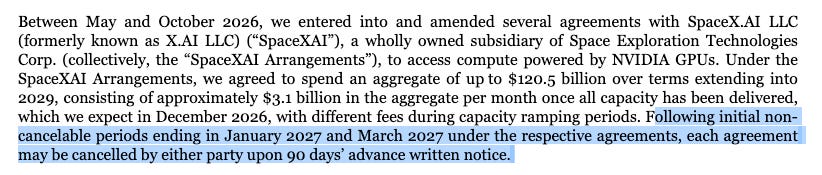
Taken at face value, these commitments imply roughly ~$75B of annualized infrastructure spending over the next decade.


Majority of revenue is usage based
About 80% of first-half revenue was usage based, compared with 20% from subscriptions. There’s no two sides about this, revenues outside of contractual minimums are exposed to changes in usage, optimization, and switches to open-weight alternatives.
However, our revenue is primarily consumption-based, and much of it is not subject to long-term contractual commitments, while our compute and infrastructure commitments generally extend over multiple years.
This creates a duration mismatch between revenue that can change relatively quickly in the face of its infra obligations and puts pressure on Anthropic to keep its models at the frontier to justify its premium token pricing.
Growth opportunities beyond coding
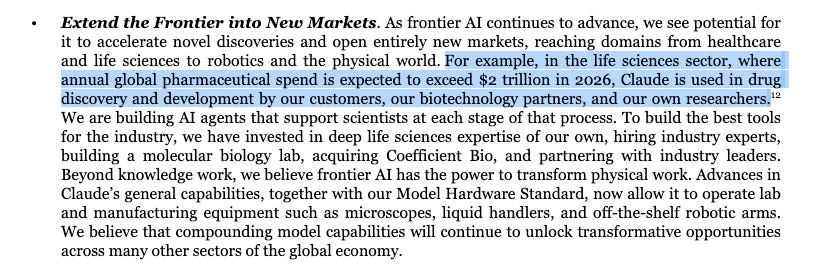
The filing points to robotics, manufacturing, logistics and drug discovery as new areas Anthropic expects to move into. I’m cautiously optimistic about these opportunities, buoyed by recent demonstrations of frontier models in robotics, CAD and industrial simulations. Still, I’m wary of assigning these opportunities too much value before there is evidence of sustained customer spending.
Memory and wafer supply constraints
The filing reiterates a mostly-known risk regarding concentration of the semiconductor supply chain. The entire industry depends on the same upstream suppliers for advanced wafer manufacturing (TSMC) and high-bandwidth memory (SK Hynix, Samsung and Micron).

Even with manufacturers expanding capacity, the supply remains relatively inelastic in the short term. Anthropic makes it clear it could struggle to secure enough hardware to meet demand.
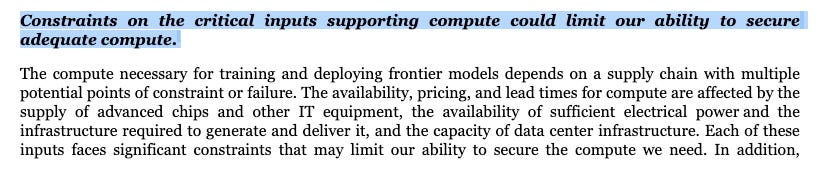
Supply scarcity also pressures Anthropic’s economics who will have limited ability to pass on higher costs to customers now that the frontier is getting even more crowded.


Summary
It should come as no surprise to anyone that demand is real, but the question of durable, growing earnings still remains in the face of enormous infra costs and competition from open-weight alternatives. For now, I see better risk-adjusted opportunities elsewhere in the AI supply chain, particularly among semiconductor suppliers with established earnings power and pricing leverage. I’ll revisit Anthropic when its IPO valuation, share count, and updated revenues are disclosed, but for now I’m not expecting to be a buyer.